
In Noah Baumbach’s debut feature film Kicking and Screaming, an aimless recent college grad played by Chris Eigeman laments himself for his fading potential and tendency to maudlin reverie: “I’m nostalgic for conversations I had yesterday. I’ve begun reminiscing events before they even occur.”
To make Rewind Barcelona, young French filmmaker Paul Nouhet called up three of his best friends from Bordeaux to recall a long weekend they spent together in the Catalan capital, around the summer they all turned 18, ostensibly to make skateboarding videos. Those friends all play themselves in the framing device, the conceit of which mirrors the film’s backstory, with adult Paul and his cowriter Emile Pierre reconnecting with their formative buddies Leo Cholet and Edouard Hascoët in an effort to reconstruct and build a film around the experience. His and his friends’ memories are fictionalized and acted out by a cast of young actors, and The self-admonition of Kicking and Screaming hangs over the film, a long grind along the rail of retrospection which mostly avoids wiping out into pure sentimentality.
Get more Little White Lies
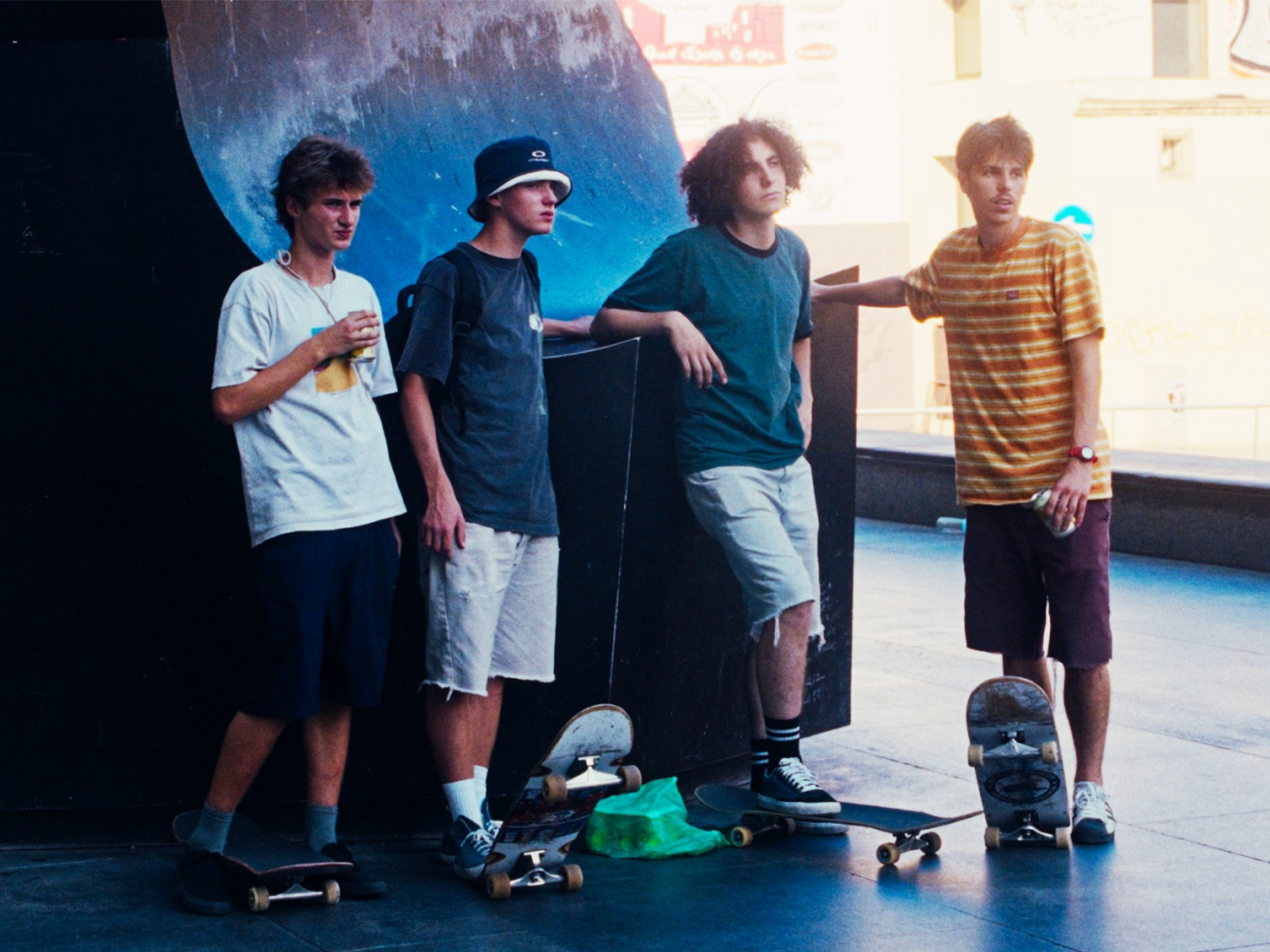
You can tell that teenage Paul is the filmmaker-surrogate from the loving close-up Nouhet gives to the probably quite expensive fisheye lens attachment he pulls out of his camera bag to film his friends at the skate park. This is a period film, after a fashion – the trip was supposed to be 10 years ago now, and the Barcelona scenes have an Instagram filter smogginess absent in the framing story, but the sharpness of digital resolution means that past and present blend together, especially at night; Nouhet withholds showing us Paul’s mini DV tapes almost entirely. Costumes are less 2010s indicators than guys being dudes: Paul sports an Oakley bucket hat, and he and his friends are largely kitted out in skate shoes, baggy shorts, and t‑shirts from random brands and sports teams. I note with some delight that young Hascoët is apparently a Boston Red Sox fan.
The four wander around Barcelona, getting nowhere near the Sagrada Familia, with the braying naïveté common to guys of their age. They play grown-up, having Leo stay by the car at check-in since they only booked the Airbnb for three guests, but entirely misunderstand the house rules; with a pretense to worldliness, they expound upon the merits of gas-station paella, and drink Damm Lemon in the street all movie. They chat up girls or get too scared to, and make lots of jokes about jacking off; there’s a light irony to the puppdoggish way they chase after an older skater friend with whom they meet up, with only Emile questioning the sustainability of his call-center job.
The actors seem to this non-skater to be credible on a board, and Nouhat, who films his young cast falling as often as landing a trick, understands that the nature of the sport is based, like growing up, in failure and repetition. Leo is distracted by some stuff going on at home, but the closest thing to suspense in the film is whether Paul will film Hascoët landing a fakie ollie off the steps of the Museu d’Art Contemporani de Barcelona, despite Emile compulsively undermining him every time he brings it up all weekend. The group dynamic is typical of male adolescent friendship, a baffling mix of thoughtless one-upsmanship and pure inchoate tenderness, with the pre-emptive lyricism of the soundtrack sometimes elbowing the movie toward the latter.
Along with the opening-night film of last year’s ACID, Sophie Letourneur’s L’Aventura, Rewind Barcelona is part of a burgeoning microgenre: the travelogue reconstructed from old home movies. In that film, a family on holiday re-narrates its own Sardinian vacation for a daughter’s diary, jumbling chronology in a formally complex memory piece about the best-laid plans of parents trying to imprint on their children. While the adult voiceover in Rewind Barcelona sometimes doubles back on itself, as characters offer contradicting accounts or struggle to fill in gaps, the difference between the event and its memory is less purposeful – partly because, only a decade or so removed from Barcelona, the quartet still banter like bros. What’s meaningful here is simply the ambient fact of their distance from their youth — the present-day portions hint at significant breakups, the milestone of home ownership, leg injuries that make skating impossible, all reminders that time, as Emie and Hascoët muse during a late-night session, “doesn’t exist, but it passes, because we age.” A certain amount of banality is therefore built into the low-stakes drama, despite snapshots in time of their various personal crises, and Paul’s inclinations toward Nouhet’s future artistic career.
In a recent New Yorker article about digital data recovery, the writer Julian Lucas recalled a family archive recorded on tape that “had aged so badly that it disintegrated in the projector […]. At the time, I was horrified. A child of the early nineties, whose first, second, and third everythings had been meticulously committed to camcorder, I could hardly imagine such a bonfire of beginnings or see that the story was an heirloom infinitely more valuable than the footage it concerned. Now I knew otherwise.” Similarly, the fact of Paul’s tapes is far more important than their contents, which is Rewind Barcelona’s weakness as well as its strength.