

Emmanuel Macron speaking at the European Industry Summit in Antwerp, Belgium.Credit: Nicolas Tucat/AFP/Getty
“Crazy” EU rules intended to ensure that green hydrogen is made sustainably are getting in the way of the technology’s scale-up, according to French President Emmanuel Macron. Macron was speaking at the European Industry Summit in Antwerp, Belgium, earlier this month. He is the latest politician in the European Union to criticize the bloc’s requirements that green hydrogen be made in a climate-friendly way, echoing Germany’s government and members of the European Parliament. Although the rules were adopted less than three years ago, the clamour for change is building, aided by pressure from some in the green-hydrogen industry — earlier this month, a handful of companies formed a new lobby group.
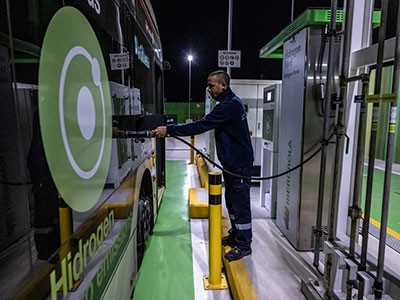
Hydrogen fuel isn’t always the green choice
Hydrogen is key to whole industries, from fertilizer manufacture to petroleum refining. That it is taking so long to scale up green-hydrogen production in the EU is a problem. Many planned projects have been delayed or scrapped. Adrian Odenweller and Falko Ueckerdt at the Potsdam Institute for Climate Impact Research in Germany tracked 190 projects globally that were due to begin operating in 2023. The researchers found that only 7% of these had begun operations as scheduled1.
But before EU leaders rush to change the rules, they need to know more about the reasons for the delays. Cost increases, supply-chain disruptions caused by the COVID-19 pandemic and regulatory requirements are all implicated, to some extent. But necessary detail— such as the relative impact of different factors — is lacking, and EU leaders need that information before they act. If the current policy is causing delays, the situation won’t be improved by replacing that policy with a hastily created alternative that fails to address the root causes of the problem.
At present, hydrogen is overwhelmingly produced using fossil energy. And, although hydrogen itself is not a greenhouse gas, its release does contribute, indirectly, to global warming. Rising atmospheric hydrogen concentrations from 2010 to 2020 drove up global surface air temperatures by around 0.02 °C, according to a study published last year by Zutao Ouyang at Stanford University in California and his colleagues2. This warming occurs mainly because hydrogen reacts with hydroxyl radicals in the atmosphere. These substances break down methane, the biggest greenhouse-gas contributor to human-caused global warming after carbon dioxide. When hydrogen reacts with hydroxyl radicals, it prevents those radicals from converting methane, slowing the speed at which the gas is broken down.

Reproductions of materials used in electrolysis in the 1800s. The equipment on the right is similar to that used to demonstrate the electrolysis of water, at the Royal Institution in London.Credit: SSPL/Getty
Most industrial, or ‘grey’, hydrogen is made by reacting methane with steam, or coal with steam and oxygen, both of which form CO2 as a by-product. The EU’s preferred greener alternative is to extract hydrogen from water using electrolysis powered by renewable energy. But those developing such facilities face strict requirements, and this is what some in the industry and some politicians are objecting to.
EU rules say that proposed green-hydrogen plants need to be powered by new sources of renewable energy, to incentivize the development of more renewable-energy facilities. Sites must also be close enough for the energy they use to be generated and consumed in the same one-hour period, to prevent fossil fuels from being used when renewables are not available.
It might seem as if these rules are to blame for the delays to the scale-up of green-hydrogen production. It could also be argued that the EU’s requirement for green-hydrogen plants to effectively be situated next door to renewable- energy sites doesn’t apply to other sectors. And yet, for all the delays and cancellations, some clean hydrogen projects did begin construction in the EU in 2025. We need to ask what distinguishes these from the delayed projects.

Why China and Europe should collaborate to ‘defossilize’ the world’s carbon
By far the best way to assess such questions is to conduct more studies, starting with reviews of the current evidence, including that for the effectiveness of alternative production methods. Electrolysis is not the only option. A form of green hydrogen can also be made from biomass, by heating crop waste to produce methane, then reacting this with steam and oxygen to make hydrogen and CO2.
This is the technology behind a large green-hydrogen facility that is being built in China. The Jiaze Renewables Corporation’s plant in Heilongjiang, which aims to produce green hydrogen, and, from that, alcohol-based aviation fuel, will have the capacity to produce 107,000 tonnes of hydrogen a year. That’s a similar capacity to a grey-hydrogen plant in Rotterdam, the Netherlands. Its operator, the gas company Air Products, based in Lehigh Valley, Pennsylvania, is coupling hydrogen production with carbon capture and storage to make the process greener.
Scientists are studying the global-warming potential of these two methods. In one study, published this month in Communications Sustainability, Moein Shamoushaki and Lenny Koh at the University of Sheffield, UK, found that electrolysis-based systems currently have a higher overall impact than do biomass-based ones, when considering the full warming potential of all the energy used in the supply chain3. That includes the energy required to extract the raw materials needed for manufacturing, as well as for storage, transport and distribution.

Read the paper: The global hydrogen budget
Importantly, the higher emissions the authors found for electrolysis systems are partly the result of the systems being modelled as using electricity directly from existing power grids. As a next step, researchers could ask the same question, but model only renewable energy as the green-hydrogen power source — as required under the existing EU rules.
Clearly, companies and politicians are struggling to scale up green energy. But before rushing to change the rules, they must, at a minimum, review the evidence. The current rules could well be in need of change. However, they might not be the main problem. Researchers can help by devising ways to ensure that green hydrogen is produced sustainably, while not unduly hampering the technology’s adoption.