
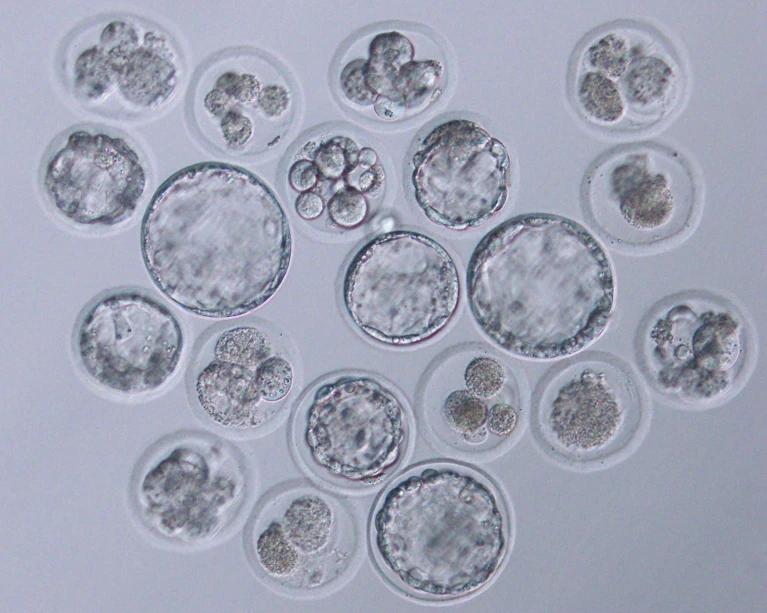
Scientists harvested eggs from 25th-generation cloned mice and fertilized the eggs, which grew into these early-stage embryos. Credit: Univ. Yamanashi
After 20 years, 58 generations and more than 30,000 cloning attempts, a team of researchers has hit the limit on the number of times a single mouse can be serially re-cloned.
The results, published on 24 March in Nature Communications1, suggest that asexual reproduction is ultimately unsustainable for mice, and potentially other mammals, too. The clones looked normal and lived as long as normal mice. But large mutations — including the loss of an entire chromosome — accumulated in the cloned lineage at an unusually high rate.
How Dolly the sheep’s legacy lives on: CRISPR cattle and cloned camels
Those DNA changes could be the reason why subsequent cloning attempts failed, the authors argue. “That probably generalizes to any kind of vertebrate cloning, which has huge implications for agriculture,” says Michael Lynch, an evolutionary biologist at Arizona State University in Tempe, who was not involved in the study. “In any kind of animal breeding, once you have the optimal genome, the best way to keep it is by cloning — except for this mutation problem.”
Amassing mutations can be particularly perilous for populations that reproduce asexually, because there is no opportunity for their genomes to mix with those of another population. “Once the mutation is in the lineage, it’s there forever,” says Lynch. “There’s no way back.”
Instant gametes
In 1997, Teruhiko Wakayama, a reproductive biologist now at the University of Yamanashi in Kofu, Japan, and his colleagues were the first to make a cloned mouse — a mouse that was an exact genetic copy of a single ‘parent’— using a non-reproductive cell from an adult animal. To do so, the scientists replaced the nucleus of a one-celled embryo with a nucleus taken from the non-reproductive or ‘somatic’ cell2.
Since then, Wakayama has continued to push the boundaries of mouse cloning. He has used nuclei taken from live mice, dead mice, dead mice that had been frozen for 16 years, freeze-dried cells and cells in mouse urine3,4. He is currently trying to clone mice from cells found in mouse faeces. He and his colleagues have also successfully used freeze-dried sperm to fertilize mouse embryos — “like instant coffee” his website says — that orbited Earth for nearly six years on the International Space Station5.

How quickly do humans mutate? Four generations help answer the question
“All the themes in my laboratory are related to the goal of permanently preserving the genetic resources of all animals,” says Wakayama.
Decades ago, he and Sayaka Wakayama, who is also a reproductive biologist at the University of Yamanashi and is married to Teruhiko Wakayama, embarked on an experiment to see how long a mouse could be preserved through cloning alone. In 2013, they reported that they had created a lineage stretching 25 generations6. “It may be possible to reclone animals indefinitely,” wrote Wakayama and his colleagues in their Cell Stem Cell paper.